Flex-PGA: On-Device Workout Classification
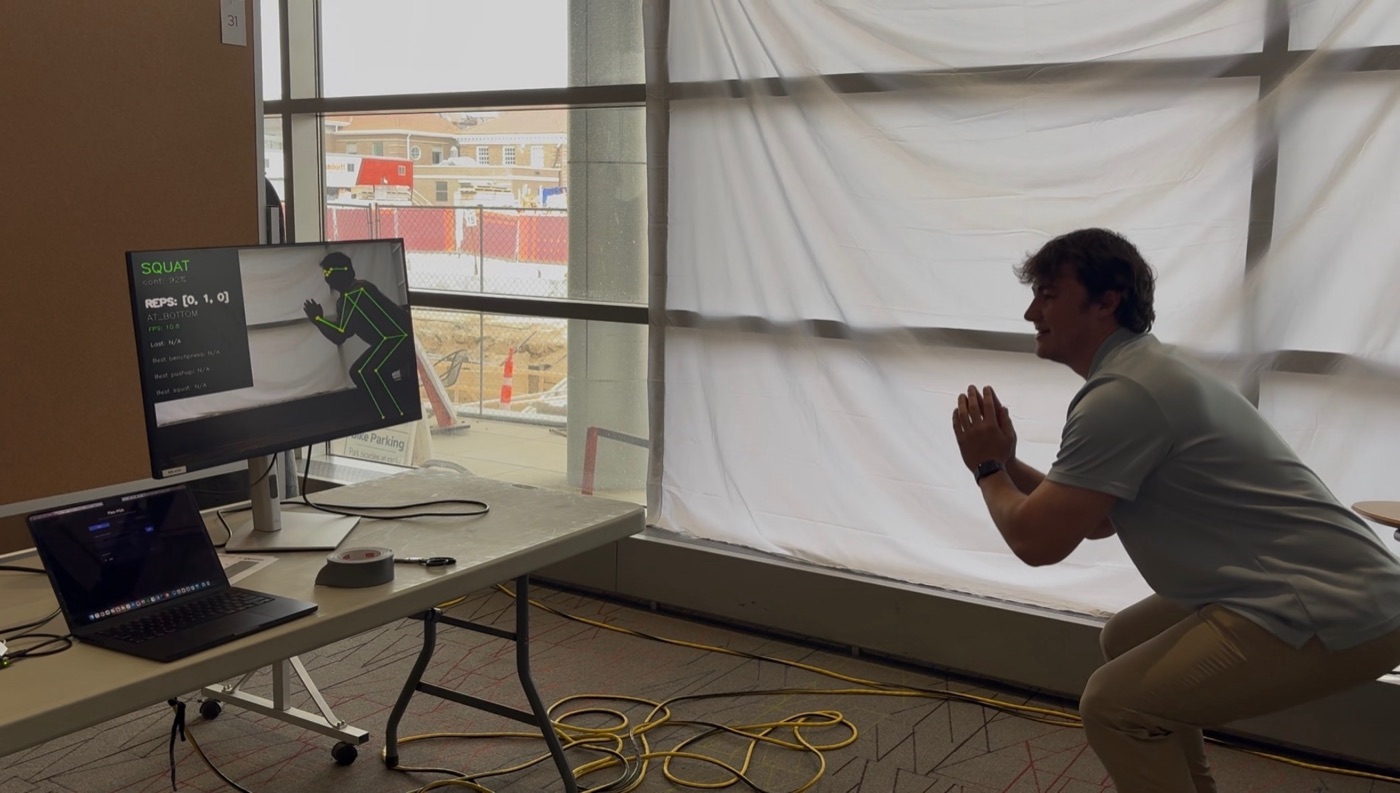
Consumer fitness apps either run vision on a phone CPU, where throttling and OS scheduling drop frames and miss reps, or stream video of your home to a server, adding latency and creating a permanent record of a private activity. Doing inference on-device fixes both: latency is bounded by hardware, and only 34 bytes of skeleton coordinates ever cross a bus.
A USB camera feeds frames to Google's pretrained MoveNet pose model running on the Zynq's ARM Cortex-A53 cores, reducing each frame to 17 body keypoints. The 34 (y, x) values are written over AXI-Lite into a custom FPGA peripheral that holds a 34→128→64→3 multilayer perceptron with int8 weights in on-chip BRAM. A hand-written SystemVerilog state machine drives a single DSP48E2 multiply-accumulate through the network and returns a class: push-up, squat, curl, or no pose. The ARM side overlays the skeleton, class, confidence, rep tally, and frame rate on a DisplayPort output.
Three decisions shaped the design. Using a pretrained pose model instead of an end-to-end CNN reduces a frame from hundreds of thousands of pixels to 34 numbers, which makes the classifier small enough to live in fabric. Int8 post-training quantization puts all 12,931 weights and biases in a single BRAM (1.6% of the device), maps each multiply onto one DSP48E2, and turns ReLU into a sign check on the accumulator. And one sequential MAC is enough: at about 1 ms per inference against a 100 ms frame budget, there was no reason to spend area on parallelism, so the classifier uses 0.28% of the device's DSPs and roughly 3% of its logic.
Pose estimation was originally designed to run in fabric on a Xilinx DPUCZDX8G. That build routed and closed timing (WNS +14.1 ns at 96.97 MHz), but occupied 99.98% of the CLBs and 95% of the DSPs, leaving no room for anything else and costing hours per synthesis iteration. The team moved pose estimation to the ARM cores and gave the fabric the workload it fit. The routed Vivado reports for both outcomes are preserved in the repo.
Results from the final report: 10 FPS throughput (target 15), 90% classification accuracy (target above 85%), 3 W power (target under 5 W), and 15% rep-counting error (target under 5%). The system was bounded by pose estimation on the ARM cores; the fabric classifier used about 1% of the per-frame budget.
My part: camera bring-up (a MIPI PCam that pivoted to USB/UVC) and the PS-side camera → shared-memory → DPU/VART inference pipeline used during the DPU integration attempt.